Why are large deposits of strategic metals associated with subduction zones?

Subduction zones are the most important places on Earth where matter is exchanged between the crust and the mantle. They are also the locations of the largest deposits of strategic metals, such as copper, molybdenum and gold, which form in the upper crust a few kilometres below the surface. But how are they formed and why are they there?

An international consortium of researchers from 5 countries (China, Australia, USA, Switzerland and France) involving GET, the CNRS Earth & Universe laboratory, has developed a thermodynamic model that explains this transfer phenomenon quantitatively for the first time, taking into account the trisulphide ion, [S3-]-, a form of sulphur recently discovered in fluids but neglected in existing scenarios. The new model shows that [S3-]- is the agent responsible for gold enrichment in the fluid when it reacts with the mantle, forming a highly soluble complex, [Au(HS)S3]-.
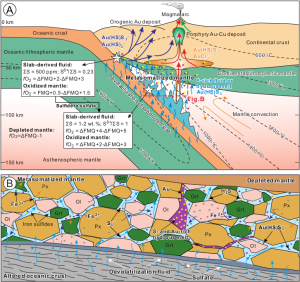
(A) Schematic of a subduction zone illustrating the transfer of gold and sulphur from the subducted plate through the mantle and into the upper crust where the major metal deposits are located. (B) Grain-scale diagram of the interaction of the fluid with mantle minerals (olivine, pyroxene), leading to enrichment of the fluid in gold © D-Y. He

Read more on the CNRS Earth & Univers website (in French)

Contact GET: Gleb Pokrovski

Sources :

D. He, K. Qiu, A.C. Simon, G.S. Pokrovski, H. Yu, J.A.D. Connolly, S. Li, S. Turner, Q. Wang, M. Yang, & J. Deng, Mantle oxidation by sulfur drives the formation of giant gold deposits in subduction zones, Proc. Natl. Acad. Sci. U.S.A. 121 (52) e2404731121, (2024).

More news

The mystery of increased runoff in the Central Sahel is better understood

The increase in runoff in the central Sahel since the onset of the drought that affected all of West Africa between 1970 and 1995 is a well-known phenomenon, but an […]

Ancient guano reveals how climate change could shape the future of seabird populations

The history of seabird population sizes prior to the Anthropocene (the modern era) remains largely unknown. This gap limits our understanding of current phenomena and our ability to predict the […]

Central African Forest: 600,000 Years of Human History Uncovered Beneath the Canopy

Archaeological excavations conducted in the Congo Basin show that these territories have been inhabited, traversed, and transformed for hundreds of thousands of years—long before Homo sapiens’ great exodus from Africa. […]

Search