Ancient guano reveals how climate change could shape the future of seabird populations
The history of seabird population sizes prior to the Anthropocene (the modern era) remains largely unknown. This gap limits our understanding of current phenomena and our ability to predict the future consequences of climate change. Researchers from an international CNRS research team, including the Toulouse Environmental Geosciences Laboratory (GET/OMP), the Laboratory for Studies in Space Geophysics and Oceanography (LEGOS/OMP), and the Center for Research on Biodiversity and the Environment (CRBE/OMP), have demonstrated that the first permanent seabird colonies on Île aux Oiseaux (South Georgia) were established between 6,800 and 6,100 years ago, more than 1,000 years earlier than previously thought. The research team also identified four distinct periods of sharp increases in seabird populations that coincide with a decrease in the intensity of westerly winds in the Southern Hemisphere.
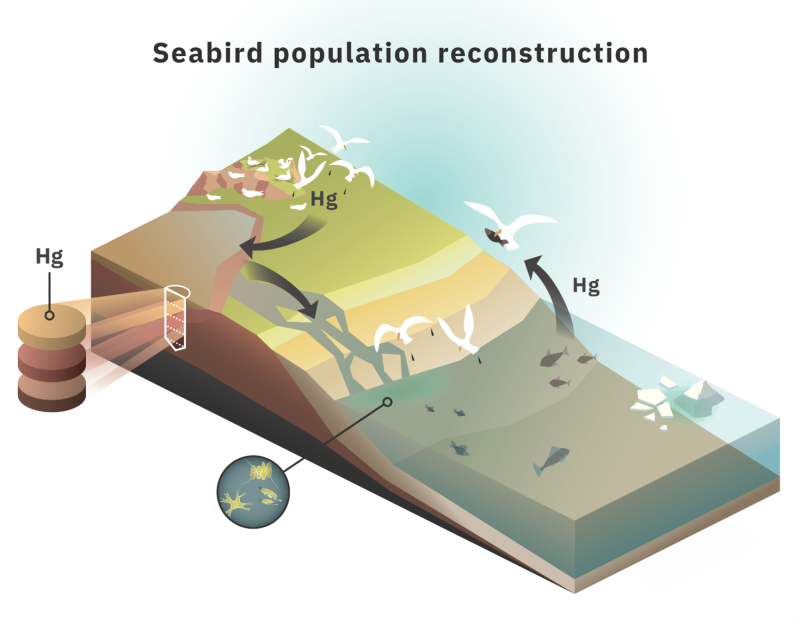
To trace the history of nesting on the island, researchers developed an innovative method: analyzing mercury levels at different depths in a peat bog located below the nesting sites. Mercury is a chemical element that bioaccumulates in organisms, with concentrations increasing as it moves up the food chain. Thus, when smaller organisms are consumed by larger ones, the predator ends up with higher concentrations of mercury. Since seabirds are apex predators, they accumulate significant amounts of mercury, and the mercury present in their prey is also found in their guano. When the guano is washed into the peat beneath the nesting sites, it gradually settles there. After collecting peat cores in the valley, the researchers were able to use the mercury content of peat layers of different ages as a reliable indicator of the size of past seabird populations.
Read more on the CNRS Terre & Univers website.
Contact GET: Jeroen Sonke