Understanding the formation of iron-rich banded rocks
Until now, scientists have considered the absence of microfossils and the low level of organic carbon in banded iron formations, deposited between 2 and 3 billion years ago, to be arguments for rejecting the potential involvement of biological activity in the construction of these formations.
But an international, multidisciplinary team coordinated by Jérémie Aubineau, a CNRS researcher at the Geosciences Environnement Toulouse laboratory (University of Toulouse), has proposed a mechanistic model that explains the potential contribution of microorganisms using iron as an energy source to the formation of the ribboned iron rocks of the early Earth.
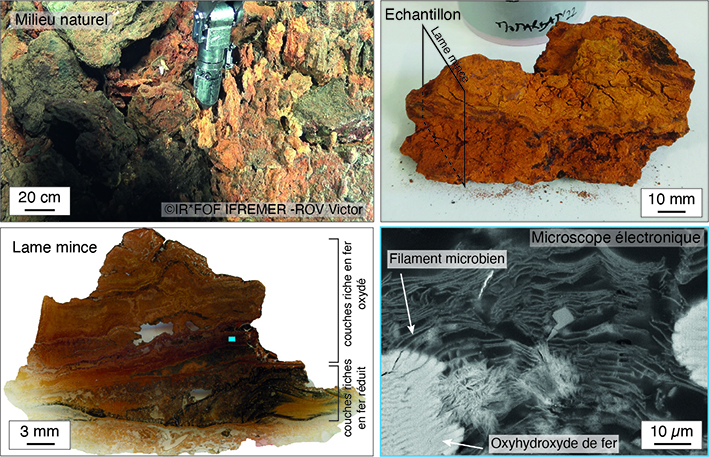
The study, presented in the journal Communications Earth & Environment, describes the successive stages of this model through the analysis of microbial colonies from an unusual natural environment. These microbial structures, which continue to develop today, originate from the Lucky Strike hydrothermal field on the Mid-Atlantic Ridge at a depth of 1,700 m, where large quantities of reduced iron are brought into the ocean. Observation of these samples suggests a strong interaction between iron-oxidizing microorganisms and their environment. When the conditions are right, these microbes precipitate filaments rich in oxidized iron, which then disappear and transform into stable minerals over time, unrelated to biological activity. Finally, as microbial colonies age, other minerals rich in reduced iron are formed as a result of biological activity. Combined, these processes form laminations rich in oxidized and reduced iron and devoid of organic carbon, reminiscent of certain structures in Precambrian banded iron formations.
Contact GET: Jérémie Aubineau, Christine Destrigneville, Valérie Chavagnac