Deep long-period earthquakes discovered beneath Massif Central volcanoes

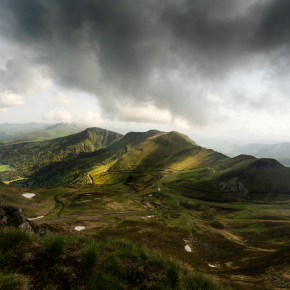
A recent study, published in Geophysical Research Letters, reveals atypical seismic signals beneath the volcanoes of the Massif Central. These signals, combined with the active presence of magma at depth, suggest that the magmatic reservoirs of the Chaîne des Puys and the Pavin “maar” (crater) may still be active, despite 6,700 years of volcanic rest.

Geological studies have shown that volcanic eruptions have affected the Massif Central over the last 65 million years, with its last eruption 6,700 years ago, at the origin of the Pavin maar. Since then, the region has been in a state of volcanic quiescence, dependent on the stability of the magmatic reservoirs presumed to be present in the crust and upper mantle.

Read more on the CNRS Terre & Univers website.

Contact GET: Sébastien Chevrot and Bastien Plazolles

Sources :

N. M. Shapiro, C. Aubert, S. Chevrot, A. Mordret, A. Paul, M. Sylvander, M. Laumonier, G. Boudoire, D. Laporte, N. Cluzel, J. Battaglia, G. Scheiblin, H. Pauchet, T. Souriot, F. Brenguier, M. Campillo, B. Plazolles, L. Gailler, E. Thébault. Deep Long Period Earthquakes Beneath Volcanoes of the French Massif Central. Geophysical Research Letters, 2025 https://doi.org/10.1029/2025GL114904

More news

Deciphering ancient oceans using pyrite and iron isotopes

Iron isotopes in pyrite are frequently used to better understand environmental conditions throughout our planet’s history, going back to sedimentary archives dating back billions of years. A team of researchers […]

A temperature jump of 400°C at a depth of 2 km—it’s possible in Krafla to cook a steak!

This study explains the heat transfer between a magma reservoir and the surrounding rock in the high-enthalpy geothermal exploration area of Krafla, Iceland. Thermomechanical numerical models explain the sudden jump […]

Life on Earth represents only a tiny fraction of possible biological forms

What forms does life take on Earth? This is the question asked by scientists from the University of Toulouse and the CNRS, who are exploring the morphological limits of life […]

Search