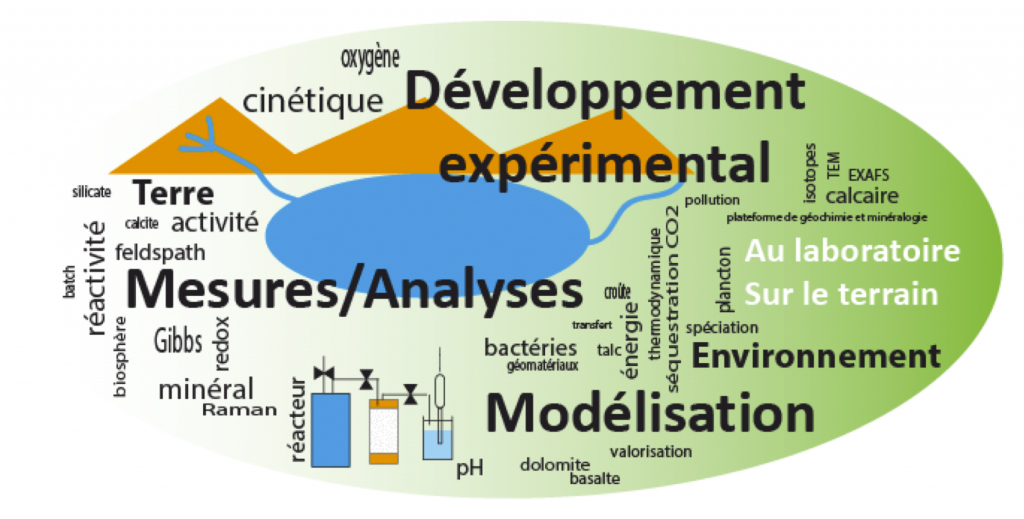
Our research is structured around the study of geochemical transfers and fluid-mineral-living interactions within the crust-hydrosphere-atmosphere system, as well as crystal nucleation and growth and the properties of nano- and geo-materials. This interdisciplinary research is at the interface between geochemistry, mineralogy, physical chemistry, microbiology, metallogeny and materials science.
Leader: Gleb POKROVSKI
We study geochemical mechanisms and transfers over a wide range of spatial and temporal scales, from the atom to the field, in various contexts such as fluid-mineral-living interactions, nucleation and crystal growth, magmatic hydrothermal systems, and properties of nano- and geo-materials.
- Resources
- Energies
- Climate change
- Materials
The fundamental experimental and numerical models developed are used in natural contexts from the deep lithosphere to permafrost, but also in more applied fields such as mineral and energy geo-resources, mineral CO2 sequestration, corrosion in nuclear power plants, or various uses of nanomaterials.
- Experimentation, in situ measurement
- Synthesis, analysis
- Spectroscopy, modeling
- Sampling, monitoring
Scientific result
Deciphering ancient oceans using pyrite and iron isotopes
Iron isotopes in pyrite are frequently used to better understand environmental conditions throughout our planet’s history, going back to sedimentary archives dating back billions of years. A team of researchers […]

Award
MSHS-T thesis prize: congratulations to Louise de Palaminy!
The International Scientific Council of the Maison des Sciences Humaines et Sociales de Toulouse (MSHS-T) has awarded its 2025 Interdisciplinary Thesis Prize jointly to Louise de Palaminy (PhD in Archaeometry) […]

Scientific result
Oxygen oases in the oceans 500 million years before oxygenation of the atmosphere
2.9-billion-year-old marine sedimentary rocks from Canada’s Red Lake region reveal areas of oxygen accumulation at a time when the oceans were globally anoxic and iron-rich. These oxygen oases played a […]

Scientific result
How can uranium isotopes help trace the history of the Earth’s oxygenation?
A recent study reveals the existence of a uranium isotopic signature specific to oxygen-depleted environments. This discovery could help to better understand the history of the co-evolution between animal life […]
Scientific result
A study conducted by scientists from the Centre for Research on Biodiversity and the Environment (CRBE – CNRS/IRD/Toulouse INP/UT) and the Géosciences Environnement Toulouse laboratory (GET – CNRS/IRD/UT/CNES) reveals that […]
Scientific result
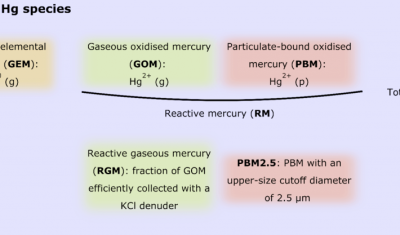
Atmospheric mercury: a decade of observations on Amsterdam Island
The recent publication of a data paper by a research team including scientists from CNRS Terre & Univers highlights a unique series of measurements of atmospheric mercury on Amsterdam Island, […]