Sedimentary phosphates: what do really date?
A better understanding of the temporal dynamics of the establishment of phosphate deposits in Morocco would allow a correct assessment of the potential. In this context, an international multidisciplinary team coordinated by Jérémie Aubineau, CNRS researcher from the Géosciences Environnement Toulouse laboratory, has published new results on the use of the so-called uranium-lead method to date the establishment of phosphate deposits. This approach does not make it possible to obtain the age of the deposits but rather provides information on the local and regional geological mechanisms which took place up to 40 million years after the formation of the phosphate grains.
Despite the economic, environmental and scientific challenges of the phosphate deposits in Morocco, the lack of precise dating of these sediments prevents the correlation of the different phosphate basins as well as the detailed understanding of the spatio-temporal processes at work during the formation of the phosphate deposits.
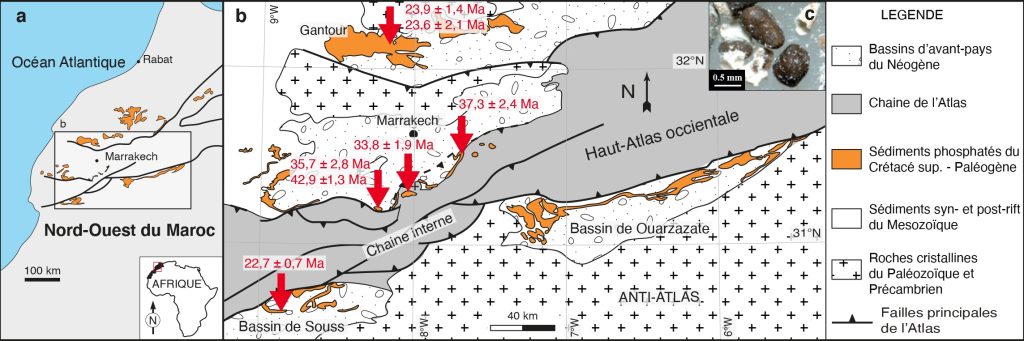
In a recently published article, a team of scientists from France, Morocco and the United Kingdom demonstrate that the U-Pb geochronological dates of phosphate grains from several sedimentary basins in Morocco are systematically younger by 25 to 40 million years than the expected stratigraphic age. The authors believe that at least two geological mechanisms are responsible for the closure of the U-Pb system of sedimentary phosphate grains. Thus, burial diagenesis and the widespread regional emergence of northwest Morocco would have inhibited the interactions between fluids and phosphate grains, which would have allowed the minerals to behave as a closed system, without addition or loss of minerals. uranium and lead.
Sedimentary phosphate minerals must therefore be used with caution to date the spatio-temporal processes responsible for the formation of phosphate deposits.