The nature and evolution of West Africa’s surface deciphered by laterites

An unprecedented cartographic synthesis on the scale of North-West Africa reveals the diversity and history of the laterites that form the film of ‘red earth’ covering tropical landscapes.

The surface of continents is a major interface on our planet where exchanges between the atmosphere, the hydrosphere and the biosphere, known as the “critical zone”, take place. In the tropical belt, these exchanges take place in particular through laterites, which are the product of the leaching of rocks by rainwater under the effect of heavy rainfall and high temperatures. Laterite blankets form the substrate of soils and ecosystems and contain important water and metal resources, with direct implications for agriculture, the economy and the management and conservation of natural environments. Excavating and mining laterites is therefore a source of environmental contamination. Finally, successive generations of laterites are archives of the global changes that have shaped the surface of continents over time.
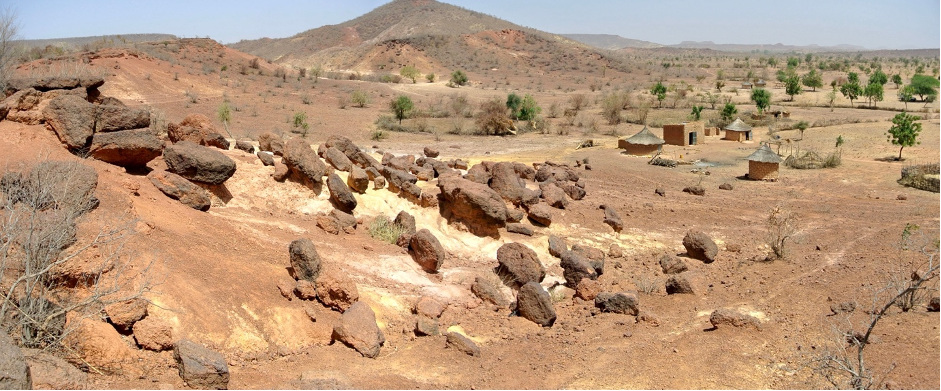
Lateritic blanket being dismantled and eroded, Kongoussi region, Burkina Faso © D. Chardon / IRD

Learn more on the INSU website.

Contact: Dominique Chardon (DR IRD / GET)

Sources :

Chardon, D., 2023. Landform-regolith patterns of Northwestern Africa: Deciphering Cenozoic surface dynamics of the tropical cratonic geosystem. Earth-Science Reviews, 104452. https://doi.org/10.1016/j.earscirev.2023.104452 OPEN ACCESS

More news

Central African Forest: 600,000 Years of Human History Uncovered Beneath the Canopy

Archaeological excavations conducted in the Congo Basin show that these territories have been inhabited, traversed, and transformed for hundreds of thousands of years—long before Homo sapiens’ great exodus from Africa. […]

10,000 Years of Food Inequality

An international team of researchers (Inrap, CNRS, Simon Fraser University) has published an article in the journal PNAS titled “Dietary Inequality Marker Reveals 10,000 Years of Gender and Cultural Disparity […]

Deciphering ancient oceans using pyrite and iron isotopes

Iron isotopes in pyrite are frequently used to better understand environmental conditions throughout our planet’s history, going back to sedimentary archives dating back billions of years. A team of researchers […]

Search