Questioning our knowledge of the chemistry of the early oceans
An international team involving a CNRS-INSU laboratory has determined the isotopic fractionations associated with greenalite, a mineral of the silicate class rich in ferrous iron (Fe2+), and has thus evaluated the hypothesis that this mineral represents the precursor of the banded iron formations deposited before the great oxygenation. The results obtained challenge the model of deposition of these sedimentary formations and our knowledge of the chemistry of the early oceans.
According to the canonical model, these sedimentary rocks, today constituted of secondary minerals, would have initially precipitated as hydrated ferric oxides (Fe3+) such as ferrihydrite, following the surface oxidation of deep anoxic waters rich in Fe2+. However, following recent petrographic studies, an alternative model has appeared in the literature with the primary precipitation of an iron silicate (Fe2+) such as greenalite.
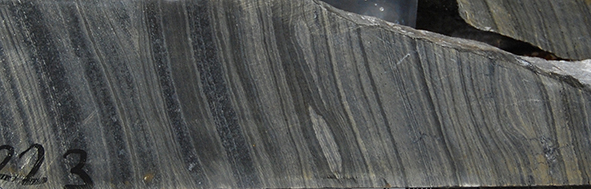
The team explored and compared the isotopic fractionations associated with greenalite and ferrihydrite, using a combined experimental (analysis of natural and synthetic samples by nuclear resonance inelastic X-ray scattering spectroscopy; NRIXS) and theoretical (ab initio atomistic modeling) approach. The results show that low Fe3+ greenalite can indeed produce all iron isotopic compositions observed in pre-oxygenation iron formations; the heaviest isotopic compositions requiring the formation of partially oxidized greenalites. From an isotopic point of view, the alternative model based on the precipitation of an iron-dominant silicate is therefore just as viable as the canonical model based on the precipitation of hydrated ferric oxides. This challenges our knowledge of the chemical characteristics of the ancient ocean. These results highlight the need to better understand the chemical behavior of iron silicates forming under primitive oceanic conditions.
This outreach on the scientific results has originally been written by the communication service of the INSU (CNRS).
Researcher contact: Marc Blanchard