On the track of an asteroid in the Sahara

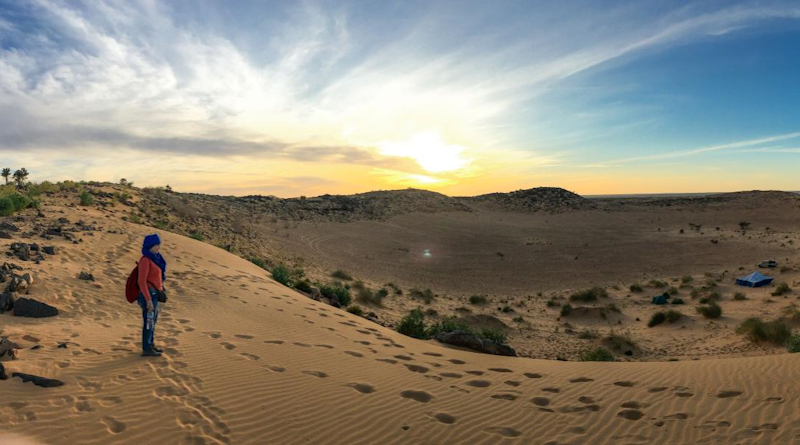
Hundreds of thousand asteroids frequently collide the Earth. They represent a danger for inhabited areas. Geologists from the GET and the University of Hassan II (Casablanca, Morocco) have explored the collisions’ consequences based on the example of the study of the Aouelloul crater in Mauritania. They published their wonderful results in Journal of African Earth Sciences.

Contact GET: David Baratoux

Read more on the IRD website (in French).

Sources :

Navee E. O. M., Aoudjehane H. C., Baratoux D., Ferrière L., Sabar M. S. O., Mhamdi H.S. 2024. Aouelloul impact crater, Mauritania : new structural, lithological, and petrographic data. Journal of African Earth Sciences, 214, 105210 [12 p.] https://doi.org/10.1016/j.jafrearsci.2024.105210

More news

Central African Forest: 600,000 Years of Human History Uncovered Beneath the Canopy

Archaeological excavations conducted in the Congo Basin show that these territories have been inhabited, traversed, and transformed for hundreds of thousands of years—long before Homo sapiens’ great exodus from Africa. […]

10,000 Years of Food Inequality

An international team of researchers (Inrap, CNRS, Simon Fraser University) has published an article in the journal PNAS titled “Dietary Inequality Marker Reveals 10,000 Years of Gender and Cultural Disparity […]

Deciphering ancient oceans using pyrite and iron isotopes

Iron isotopes in pyrite are frequently used to better understand environmental conditions throughout our planet’s history, going back to sedimentary archives dating back billions of years. A team of researchers […]

Search