
Deciphering ancient oceans using pyrite and iron isotopes
Iron isotopes in pyrite are frequently used to better understand environmental conditions throughout our planet’s history, going back to sedimentary archives dating back billions of years. A team of researchers from the GET (University of Toulouse) and IMPMC (Sorbonne University) laboratories combined experimental approaches, isotopic analyses, and theoretical modeling to elucidate the mechanisms of low-temperature pyrite formation. Their results show that the isotopic signature of iron in pyrite is a reliable marker of abiotic processes, regardless of the trace elements present. This is an important step forward in interpreting geological archives and better understanding the evolution of the Earth.
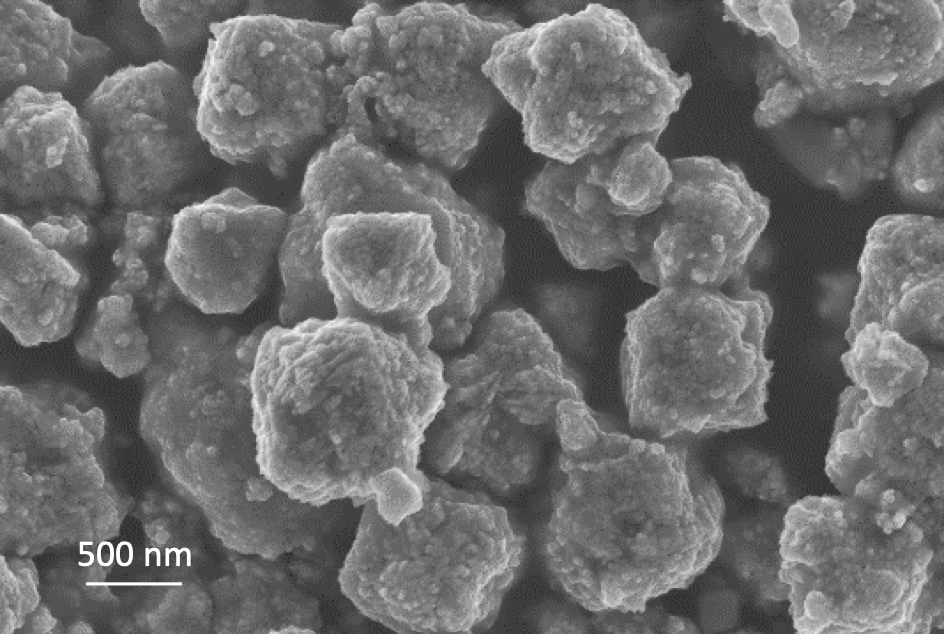
Pyrite (FeS₂), found in ancient sediments, records the chemical conditions of the oceans and atmosphere of the early Earth. Iron isotopes, in particular, are valuable indicators of past geochemical processes. However, the pathways of pyrite formation and their impact on the distribution of iron isotopes remain poorly understood, limiting our ability to correctly interpret these geological archives.
The researchers reproduced the formation of pyrite in the laboratory using the polysulfide pathway, one of the two main mechanisms by which this mineral forms in nature. They tracked the evolution of iron isotopes in solids and solutions over time, with and without trace elements such as nickel and arsenic, which are known to influence the kinetics of pyrite formation. The experiments were conducted under strictly anoxic (oxygen-free) conditions, similar to those found in primitive oceans.
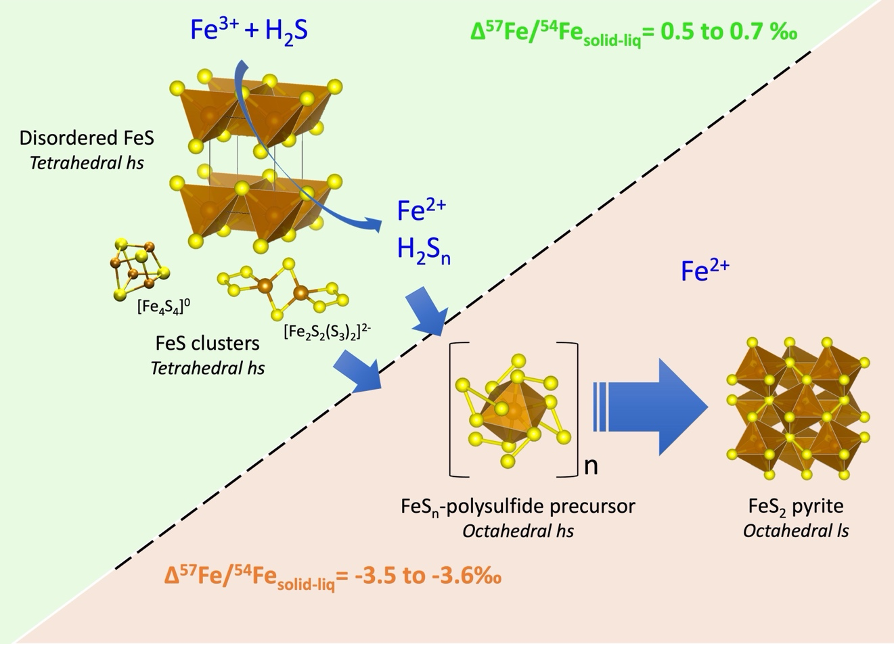
The study reveals that the formation of pyrite is accompanied by a sharp reversal in the distribution of iron isotopes between the solid and the solution. At the start of the experiment, the solids are slightly enriched in heavy iron isotopes, but as soon as pyrite begins to form, their isotopic composition becomes much lighter. This phenomenon is independent of the presence of nickel or arsenic. The study also shows that the final isotopic fractionation is always the same, regardless of the reaction time or the presence of trace elements. This result suggests that the isotopic signature of iron in pyrite is controlled by a common kinetic mechanism involving a light iron molecular intermediate, which forms before the crystallization of pyrite and gives it its final isotopic composition.
This study thus provides a unified understanding of the abiotic formation mechanisms of pyrite. It shows that the light iron isotopic signatures often observed in Archean pyrites can be produced by purely abiotic processes. These results challenge the commonly held explanation that these signatures are systematically linked to microbial activities, such as dissimilatory iron reduction.
Contacts GET: Franck Poitrasson, Marc Blanchard, Romain Guilbaud