
MACIV nodes: an exceptional seismological network on the volcanoes of the Massif Central
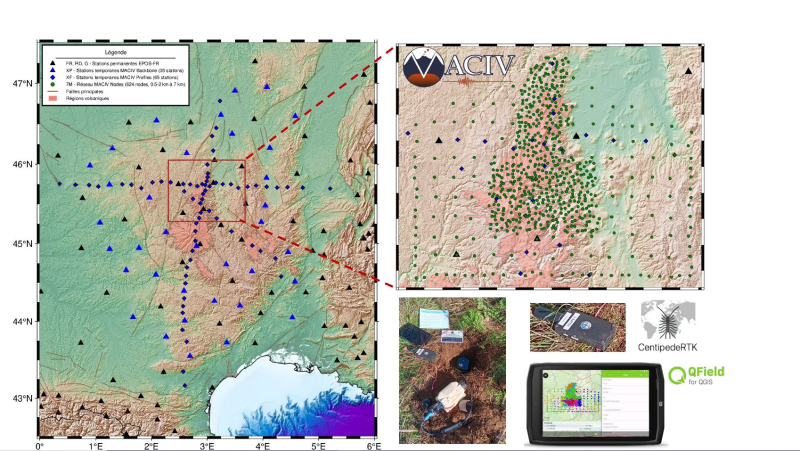
As part of the MACIV project, funded by the French National Research Agency (ANR), a team of scientists deployed the largest mobile seismological network ever installed by a university team in September 2025. This exceptional device, comprising 624 sensors covering an area of 80 x 100 km² in the heart of the Massif Central, aims to provide detailed images of volcanic systems between 0 and 10 km deep.
From September 15 to 24, 2025, fourteen engineers, doctoral students, and researchers from various laboratories (see box) installed this network. Comprising 624 sensors spread over an area of 80 × 100 km², this device aims to image the potentially active volcanic systems of the Massif Central, such as the Chaîne des Puys and the Monts-Dore, whose last eruptions date back less than 10,000 years.
Read more on the CNRS Terre & Univers website (in French).
Collaborators from GET involved in the project: Stéphanie Duchêne, Sébastien Chevrot, Olivier Vanderhaeghe