Unprecedented mineral and organic compounds discovered in Mars’ Jezero Crater

The Perseverance rover has uncovered sedimentary rocks containing minerals and organic matter organized into structures never before seen on Mars, opening up new perspectives on the Red Planet’s past habitability.

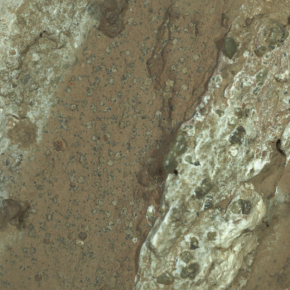
Research teams involving several CNRS Terre & Univers laboratories used NASA’s Perseverance rover to analyze intriguing spotted rocks found in the sediments of a valley in Jezero Crater, in the geological formation known as “Bright Angel.” This study reveals unprecedented mineral and organic associations.

Detailed analysis of these sedimentary rocks has revealed the presence of organic matter—i.e., carbon-based molecules—closely associated with phosphate and iron sulfide minerals, concentrated in the form of submillimeter nodules and millimeter-scale reaction fronts.

Read more on the INSU (CNRS Terre & Univers) website (in French)

Contact GET: Gwénaël Caravaca

Sources :

Hurowitz, J.A. et al. Redox-driven mineral and organic associations in Jezero Crater, Mars. Nature (2025). https://doi.org/10.1038/s41586-025-09413-0

More news

10,000 Years of Food Inequality

An international team of researchers (Inrap, CNRS, Simon Fraser University) has published an article in the journal PNAS titled “Dietary Inequality Marker Reveals 10,000 Years of Gender and Cultural Disparity […]

Deciphering ancient oceans using pyrite and iron isotopes

Iron isotopes in pyrite are frequently used to better understand environmental conditions throughout our planet’s history, going back to sedimentary archives dating back billions of years. A team of researchers […]

A temperature jump of 400°C at a depth of 2 km—it’s possible in Krafla to cook a steak!

This study explains the heat transfer between a magma reservoir and the surrounding rock in the high-enthalpy geothermal exploration area of Krafla, Iceland. Thermomechanical numerical models explain the sudden jump […]

Search