
A New Estimate of the Current Mantle Temperature Based on MORB
A study published in Nature Communications reevaluates the potential temperature of the Earth’s current mantle and, consequently, the extent of its cooling over the past two billion years. The results indicate that the current ambient mantle is likely hotter than the standard value of ~1350 °C often used in geodynamic models. Depending on the assumptions made regarding the oxidation state of iron, the estimates converge toward a dominant temperature range close to 1,400–1,440 °C.
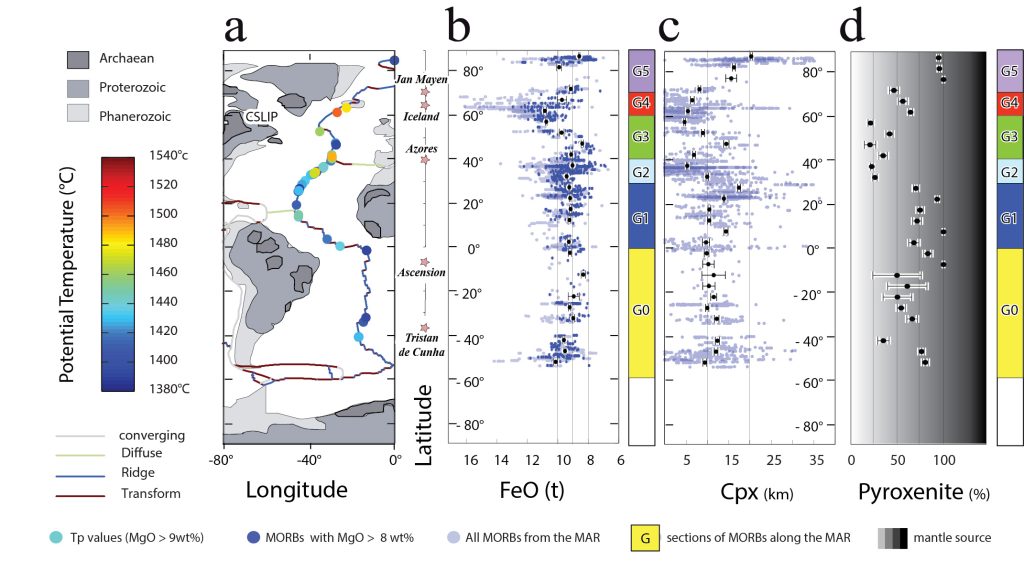
The study also shows that it is preferable to describe the present-day mantle using a temperature distribution rather than a single value: the observed variations between the Atlantic, Pacific, and Indian Oceans, as well as the local contributions of mantle plumes, are an intrinsic part of the signal. This reassessment of the present-day endpoints of the cooling curves implies a relatively moderate secular cooling, likely less than ~150 °C since the Paleoproterozoic. It thus reduces the thermal gap between the Earth of two billion years ago and the present-day Earth, with implications for our understanding of the evolution of mantle convection and plate tectonics. This work is part of a long series of studies conducted at the GET on the Earth’s thermal evolution, the petrology of mantle magmas, and the dynamics of Precambrian lithospheres, particularly in West Africa.
Contact: Jérôme Ganne