Volcanic eruption: a new chronometer based on the diffusion of titanium in quartz

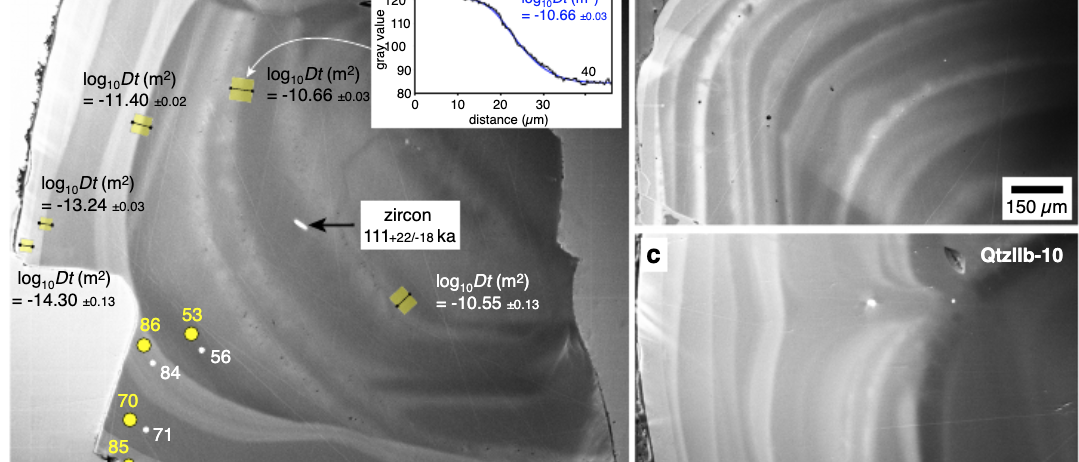
The process by which volcanic eruptions are triggered is still unpredictable. In order to assess the residence time of the magma in the chamber until the eruption, the international team, including scientists from CNRS-INSU, has used a clever method to establish the speed of diffusion of titanium (Ti) in natural quartz. The method involves dating the zircon micro-inclusions with very high precision and measuring the Ti micro-profiles in the quartz using cathodoluminescence imaging. This revolutionary new chronometer is based on analyses of the quartz in the volcanic pumice from Mount Pinatubo, Philippines, which erupted in 1991.
Read more on the INSU website.

GET contact: Anastassia Borisova

Sources :

Audétat, A., Schmitt, A.K., Njul, R. Saalfeld M., Borisova A. & Lu Y. New constraints on Ti diffusion in quartz and the priming of silicic volcanic eruptions. Nature Communications 14, 4277 (2023). https://doi.org/10.1038/s41467-023-39912-5

More news

A temperature jump of 400°C at a depth of 2 km—it’s possible in Krafla to cook a steak!

This study explains the heat transfer between a magma reservoir and the surrounding rock in the high-enthalpy geothermal exploration area of Krafla, Iceland. Thermomechanical numerical models explain the sudden jump […]

Life on Earth represents only a tiny fraction of possible biological forms

What forms does life take on Earth? This is the question asked by scientists from the University of Toulouse and the CNRS, who are exploring the morphological limits of life […]

MACIV nodes: an exceptional seismological network on the volcanoes of the Massif Central

As part of the MACIV project, funded by the French National Research Agency (ANR), a team of scientists deployed the largest mobile seismological network ever installed by a university team […]

Search