The Gargas Cave in the Wake of Climate Change
Efforts to preserve an exceptional site like Gargas began many years ago. Temperature monitoring (air and rock walls) at three locations within the site has been in place since the 1990s. Initially, the primary conservation risk stemmed from excessive visitor traffic. But today, the warming of the subsurface caused by climate change far exceeds the thermal impact of visits. Over the past 10 years, the temperature in the Gargas Cave has risen by 0.5°C, with pronounced temperature disparities between deeper and shallower sections that are altering the cave’s internal airflow patterns.
The objective of the ANR DECALIM project [DEcorated CAves under CLIMate changes: Redefining an effective conservation strategy], led by Bruno Lartiges, Professor at the University of Toulouse, is to study the extent to which thermal impact alters the conservation conditions of the cave paintings. Sensors capable of detecting convection cells, measuring the thickness of water films on the walls, temperature, and evaporation or condensation rates have been installed. In total, more than 70 devices are dedicated to monitoring the Gargas caves, enabling the prediction of drying and/or humidification of the walls.
The measurements are so sensitive that even the presence of the researchers can interfere with them. That is why GET, through its electronics engineer, Loïc Drigo, has developed wireless electronic systems distributed throughout the cave. These systems transmit the data to the surface, where a final module relays it to a constellation of satellites and on to GET.
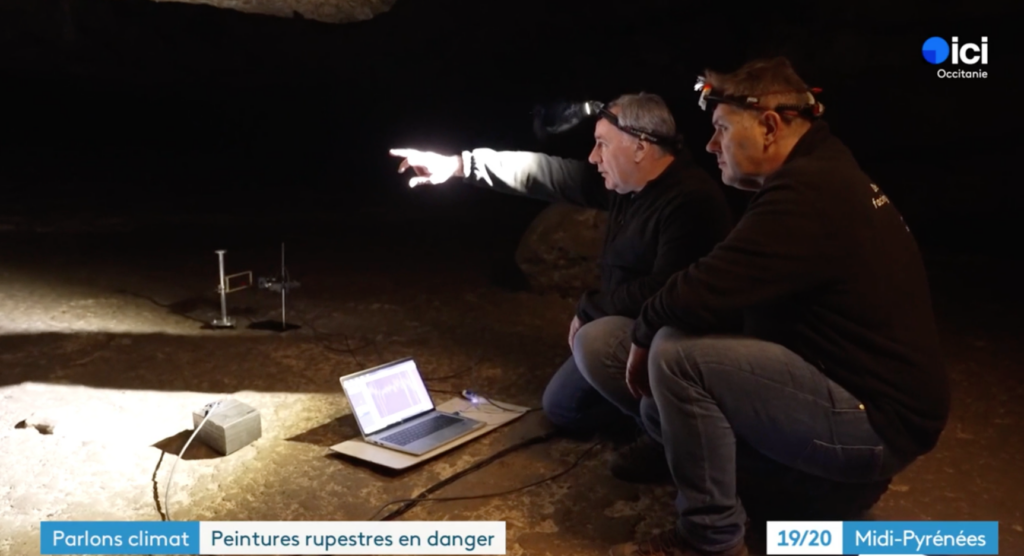
This project was the subject of a short report by ICI Occitanie, available for replay here in French (at 10′).
GET Contacts: Loïc Drigo and Bruno Lartiges